
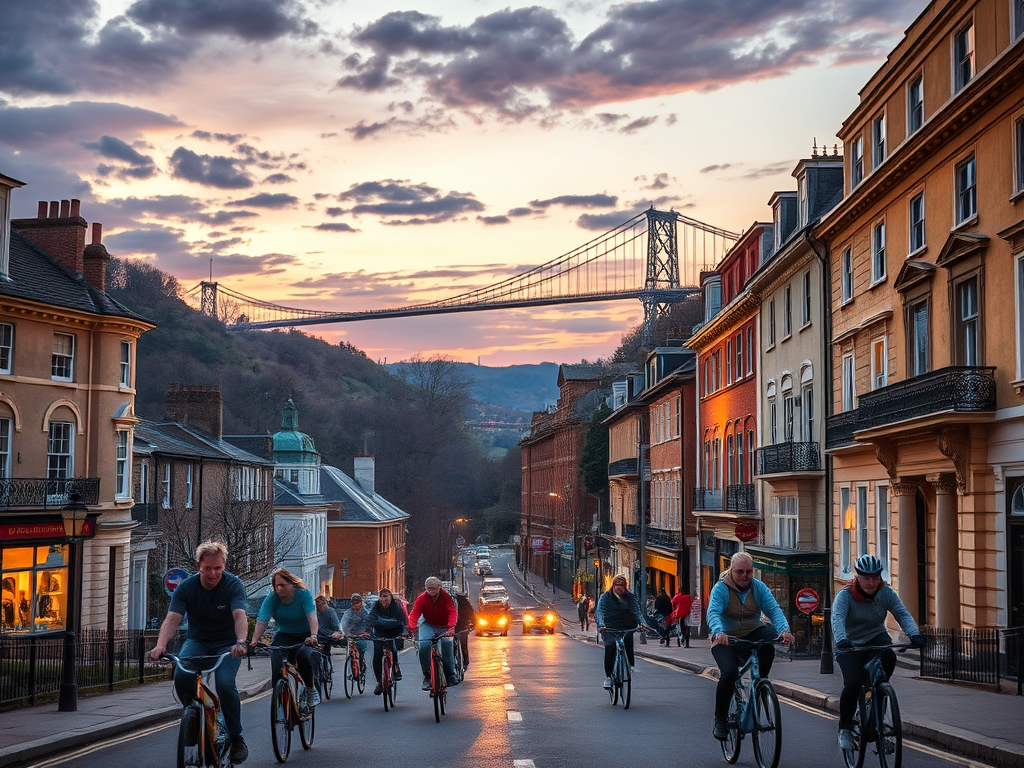
There are cities that speak in whispers, and there are others that sing. Bristol, with its hills rolling like the folds of an ancient cloak and its streets rising and falling in restless rhythm, does both. To the medical student who arrives wide-eyed and breathless, clutching a place won through courage and relentless toil, Bristol greets them with a voice that is at once bold and intimate. It is a city that seems to breathe with them — in their moments of doubt, in their bursts of triumph, in the long nights when books whisper and the pulse of ambition beats louder than sleep.
Bristol does not hide its history behind stone facades alone. It parades it openly across the suspension bridge stretching like a silver blade above the Avon Gorge, where winds rush with the force of freedom and fear, and where students often wander at dusk seeking a moment of stillness before plunging back into the ocean of their studies. The bridge stands with a solemn grace, its chains gleaming under lantern-coloured skies, its pillars rising like the ribs of a titan. Beneath it, the river courses with ancient insistence, as though carrying the confessions of every generation that has stood above it dreaming of what they might one day become.
It is in the heart of the medical school, nestled among buildings both austere and modern, that these dreams take form. In lecture halls where sunlight slants across wooden desks, students sit with pens poised like small weapons against the vast unknown. Anatomy begins with a reverence they did not expect: the quiet lowering of a sheet, the first glimpse of the body that will teach them lessons no living teacher could. There is a hush that falls not because the moment is required to be solemn but because it could not be otherwise. Even the most talkative fall silent before the mystery of flesh and bone revealed.
Their voices later fill the digital world — honest, weary, hopeful. On late-night posts where the screen glows against tear-tired faces, they speak of moments when the weight of study threatens to pull them under. They confess to fears that their minds are not enough, that others seem more brilliant, more prepared, more certain. They share victories too: passing a difficult exam, performing their first proper clinical skill in a hospital ward, recognising a heart murmur without prompting. Each post becomes a marker on the map of their becoming, fragile yet triumphant.
The city shapes them in ways they do not at first understand. Its hills are not merely geographical burdens but metaphors revealed daily. On their bicycles they labour up Park Street, breath catching in their chests as though the hill itself were testing their resolve. The buildings along the ascent — grand, Georgian, steadfast — seem to murmur encouragement. And when they reach the top, where the Wills Memorial Tower pierces the sky in proud defiance, the view unfurls beneath them: the harbour glinting, the crooked lanes weaving their quiet spells, the city pulsing with life. Here, at this height, it becomes impossible not to feel that something extraordinary is just within reach.
In the taverns and cafés tucked between the city’s slopes, the students find warmth. Some gather in small groups over steaming cups of coffee, spreading lecture notes across tables worn smooth by decades of elbows and ink stains. Others retreat alone to quiet corners of the university library, where lamps burn like watchful stars above their bent heads. Books pile around them like small fortresses against confusion, and in the hour before closing time, when silence thickens and pens scratch with urgent finality, they discover resilience they never suspected they possessed.
But their world extends far beyond libraries and lecture theatres. When clinical placements begin, they step into hospitals where the air hums with urgency. Here, among the labyrinth of corridors that smell faintly of disinfectant and hope, the true nature of medicine breathes hot against their cheeks. A crying child, a frail hand seeking reassurance, a heart monitor pulsing with an uneven rhythm — these are the lessons that no textbook can tame. They walk carefully at first, like visitors in a sacred space. Then, slowly, they learn to carry themselves with a quiet certainty. They discover that empathy is not an accessory but an instrument. They learn to listen not only to words but to silence. And beneath their nervous smiles, a sense of purpose begins to take root, curling like ivy around the bones of their ambition.
Their peers on social media joke about the chaos of placements — the long bus journeys across the city at dawn, the unexpected kindness of nurses who teach them more in ten minutes than a month of lectures ever could, the moment they stand alone in a corridor realising they’ve forgotten which ward they were sent to. These confessions, tinged with humour and affection, become a kind of communal diary. They show that Bristol’s medical students do not face their struggles in isolation but woven into the broad tapestry of peers and mentors who carry them through.
Life in the city moves with a rhythm that is unlike any other. The medical students inhabit a dual existence: half scholar, half wanderer. By day they wrestle with physiology pathways and pharmacology charts; by evening they drift through the harbourside, where boats rest against the water with gentle sighs and lights flicker across the ripples like drifting lanterns. Couples stroll hand in hand along the quays, friends gather at the water’s edge with laughter that rings against the old brick walls, and the scent of food from the stalls mingles with the cool tang of the tide. The students walk among them feeling briefly, blissfully, like ordinary citizens unburdened by the weight of learning.
Yet it is on quiet mornings, before the city fully wakes, that Bristol reveals its deepest tenderness. Mist crawls along the river like a shy animal, clinging to the moorings and drifting over the cobbles. Buses hum softly, their windows glowing as if offering a beacon of courage. Students wrapped in scarves move through the fog with books pressed close, finding that this solitude, this hush, is a balm against the restless storm of study. They breathe in the cool air, steadying themselves for the day ahead, and in those moments they understand that becoming a doctor is not only about knowledge or skill — it is about patience, perseverance, and a quiet faith in their own unfolding.
In some colleges and university residences scattered across the city’s patchwork of hills, they learn to build something like home. Kitchens become confessionals where exhausted students pour tea into mismatched mugs and speak of exams, heartbreak, or the peculiar loneliness that sometimes swells amid crowds. Shared laughter rises like music against the thin walls. Nights spent revising together tend to dissolve into stories about lecturers, consultations, or the strange, defiant rituals needed to survive medical school. By the time dawn smears pale violet across the sky, they feel bonded in a way only hardship can forge.
Bristol is not always gentle. The wind sweeping through Clifton can be sharp as a reprimand, and the rain falls with a wildness that tests the spirits of those caught beneath it. Deadlines close in like gathering clouds, and there are evenings when no amount of coffee, or warmth, or friendship can dispel the heaviness of doubt. Yet the city never abandons them. Its very character — bold, unashamed, uncontained — seems to push them back onto their feet. To be a medical student here is to learn resilience not as an abstract virtue but as a companion that walks beside you up every hill.
As the years unfurl and they move deeper into the world of clinical medicine, the students begin to see Bristol differently. No longer merely backdrop, the city becomes metaphor. Its energy — its defiance, creativity, and irreverent humour — mirrors their own growth. They realise that, like Bristol itself, they can carry contradictions without breaking: determined yet doubtful, weary yet hopeful, solitary yet never truly alone.
By their final year, when they walk along the quays with coats buttoned tightly against the wind, they do so with eyes both seasoned and softened. They remember the trembling excitement of their first day, the impossible hills they once dreaded cycling up, the long nights spent poring over anatomy they feared they would never master. They remember the first patient who looked at them with trust, the first time they felt truly useful, the first time the weight of responsibility settled on their shoulders like a cloak that was both heavy and honourable.
They stand again at the edge of the suspension bridge, watching light scatter across the deep gorge, and feel a strange quietness inside. For the city has prepared them. It has shaped them with its winds, challenged them with its hills, nourished them with its fierce beauty, and carried them with its sprawling, beating heart. They have become, as all doctors must, both strong and gentle. And Bristol — bold, generous, unafraid — is etched upon their spirit.
When at last they leave the university to enter the world as fledgling physicians, they do so carrying something far greater than a degree. They carry Bristol itself: its laughter, its storms, its daring architecture and restless tides. They carry the memory of the first body they dissected, the first diagnosis they attempted, the first friendship that held them steady. They carry the city’s defiant belief that life, even at its darkest, can be met with courage.
And somewhere, in a room overlooking the harbour or a bench on the Downs where they once sat watching clouds drift over the city, a younger student is beginning the journey anew — trembling, hopeful, ready to learn what Bristol whispers only to the brave.


Leave a Reply