
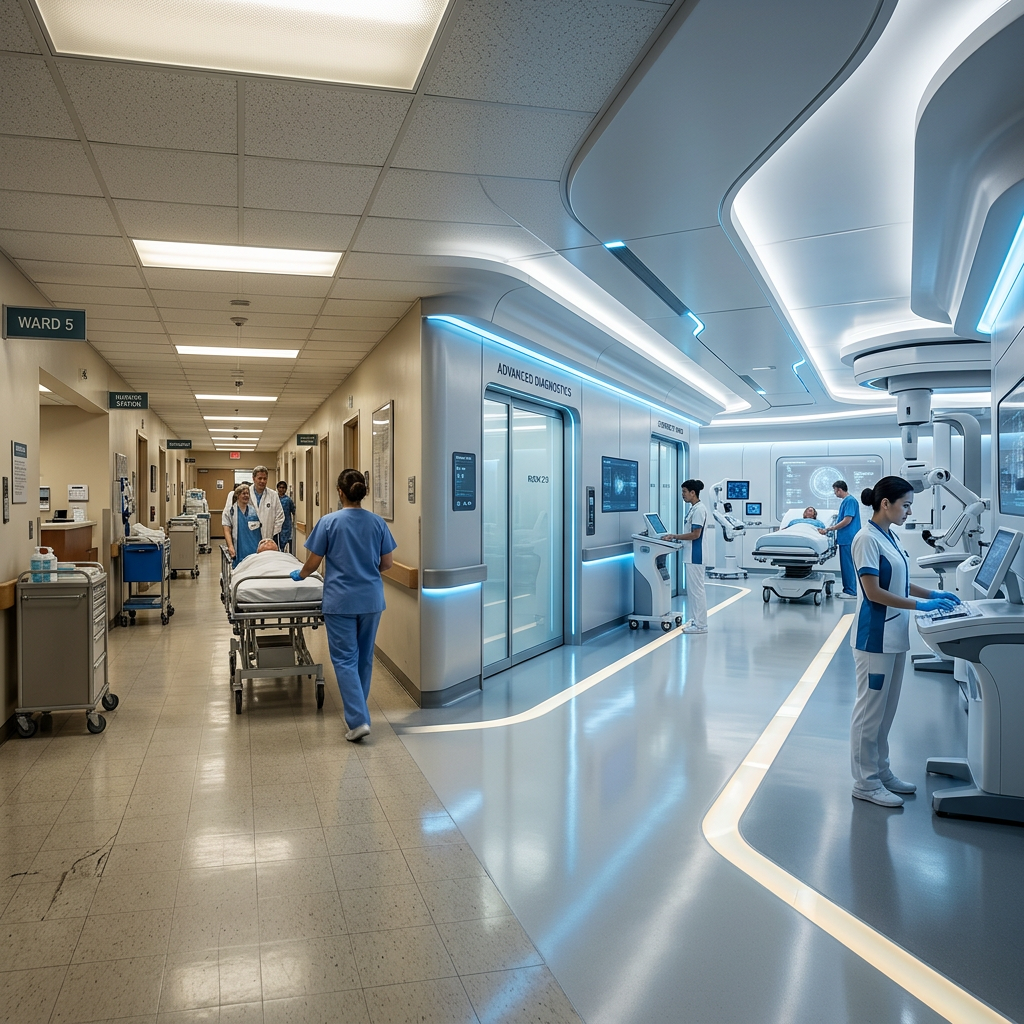
There is a quiet shift taking place in British medicine, one that most applicants sense but few fully grasp. It does not appear in prospectuses or open day presentations. It is not discussed in the polished language of admissions websites. And yet, it will shape the careers of every student entering medical school this decade.
The role of the doctor is changing.
Not dramatically, not overnight—but steadily, and with a direction that is becoming harder to ignore. For the applicant in 2026, this matters. Not because it alters the fundamentals of medicine, but because it reframes what it means to train, to practise, and ultimately, to build a career within the NHS.
The first sign of this change is structural.
The government’s Long Term Workforce Plan, published with considerable ambition, outlines a future in which the number of medical school places will expand significantly. By 2031, the target is fifteen thousand students per year—nearly double the intake of a decade ago. On the surface, this appears to be a straightforward response to workforce shortages.
More doctors, fewer gaps.
But the reality is more complex.
An increase in student numbers does not automatically translate into an increase in training posts, consultant positions, or long-term opportunities. The pipeline is not infinitely elastic. Expanding entry at the undergraduate level creates pressure further down the line—at foundation training, at specialty recruitment, at consultant appointments.
For applicants, this introduces a new variable.
Competition does not end at medical school entry. In many ways, it intensifies.
Historically, gaining a place at medical school was the primary hurdle. Once inside, progression through the system, while demanding, was relatively predictable. Today, that predictability is diminishing. Bottlenecks are emerging, particularly in popular specialties. Training pathways are lengthening. The journey from student to consultant is becoming less linear.
This is not a reason to be discouraged. But it is a reason to be informed.
The second shift is technological.
Artificial intelligence, digital diagnostics, remote monitoring—terms that once belonged to the periphery of medicine are now moving towards the centre. For applicants, these developments often feel abstract, something to be considered in the distant future.
They are not.
Already, AI-assisted imaging is being integrated into radiology workflows. Decision-support systems are influencing clinical pathways. Remote consultations, accelerated by necessity during the pandemic, have become embedded in primary care.
The question is not whether technology will replace doctors. It will not.
The question is how the role of the doctor will adapt.
Routine tasks—pattern recognition, data processing, even elements of diagnosis—are increasingly supported by technology. This does not diminish the need for doctors. It changes where their value lies.
Interpretation. Communication. Ethical judgement.
The human aspects of medicine, often difficult to quantify, become more central as technical processes are augmented or automated. For the future doctor, the ability to navigate complexity, to explain uncertainty, to build trust—these will be as important as clinical knowledge.
Applicants who understand this early have an advantage.
Not in terms of admissions scores, but in mindset.
They approach medicine not as a static profession, but as one that evolves. They recognise that adaptability is not optional. It is fundamental.
The third shift is cultural.
The NHS, like many healthcare systems, is undergoing a period of introspection. Issues of workload, burnout, retention—once discussed quietly—are now part of the public conversation. Junior doctors speak openly about their experiences. Industrial action, once rare, has become a visible expression of underlying tensions.
For applicants, this can be unsettling.
The image of medicine as a stable, respected, and secure career is being re-examined. The reality, as always, is more nuanced.
Medicine remains a deeply meaningful profession. It offers intellectual challenge, human connection, and the opportunity to make a tangible difference. But it also demands resilience. Long hours, emotional strain, systemic pressures—these are part of the landscape.
The applicants who thrive are not those who ignore these realities, but those who engage with them honestly.
They ask difficult questions.
What does work-life balance look like in practice? How do doctors sustain themselves over decades? What support systems exist, and where are the gaps?
These are not questions that admissions tutors expect fully formed answers to. But they do expect awareness.
A mature understanding of the profession—not idealised, not cynical, but realistic.
This brings us to another, less visible shift: the diversification of roles within medicine.
The traditional image of the doctor—hospital-based, progressing through a defined specialty pathway—is no longer the only model. Portfolio careers are becoming more common. Doctors combine clinical work with research, education, leadership, or entrepreneurship.
Some move into digital health, working at the interface of medicine and technology. Others engage in policy, shaping healthcare systems at a broader level. A growing number explore global health, sustainability, or interdisciplinary fields.
For applicants, this expands the horizon.
Medicine is not a single path, but a framework within which multiple careers can develop. The degree is a foundation, not a constraint.
Understanding this can be liberating.
It shifts the focus from choosing a lifelong trajectory at seventeen to developing a set of skills that remain valuable across contexts. Critical thinking. Communication. Ethical reasoning. These are transferable, adaptable, enduring.
And they are increasingly what the profession demands.
There is also a geographical dimension to consider.
As medical school places expand, many of the new or growing programmes are located outside traditional urban centres. Coastal towns, rural regions, areas with historically lower doctor-to-patient ratios.
For applicants, this presents both opportunity and challenge.
Opportunity, because these programmes often have less saturated applicant pools, increasing the likelihood of entry. Challenge, because they may require relocation, adaptation to new environments, and a willingness to step outside familiar settings.
But there is also a broader implication.
Training in these areas exposes students to different patient populations, different healthcare challenges, different perspectives. It can shape not only where they train, but how they practise.
In a system that increasingly values flexibility and responsiveness, this exposure is significant.
And so, the question for the applicant in 2026 is not simply, “Can I get into medical school?” It is, “What kind of doctor do I want to become in a system that is changing?”
The answer does not need to be definitive. It rarely is.
But the process of considering it—of engaging with the future, rather than focusing solely on the present—can inform decisions in subtle but important ways.
Which universities to apply to. Which experiences to seek. How to approach interviews. Even how to frame one’s motivation.
Admissions tutors, for their part, are increasingly attentive to this.
They are not expecting applicants to predict the future. But they are looking for signs of curiosity, of awareness, of the ability to think beyond immediate goals.
Because medicine, perhaps more than any other profession, requires a long view.
The students entering in 2026 will qualify in the early 2030s. They will practise through decades of technological advancement, demographic change, and evolving healthcare needs.
The decisions they make now are the first steps in that journey.
And like all first steps, they are taken with incomplete information.
There is uncertainty. There are risks. There are variables beyond anyone’s control.
But there is also agency.
The ability to choose thoughtfully. To prepare intelligently. To engage with the process not as a series of hurdles, but as an introduction to the realities of the profession.
In that sense, the future of doctors in the UK is not something that happens to applicants.
It is something they begin to shape, even before they receive their first offer.
Quietly, perhaps. Imperfectly, certainly.
But decisively.
And for those paying attention, the signals are already there.


Leave a Reply