
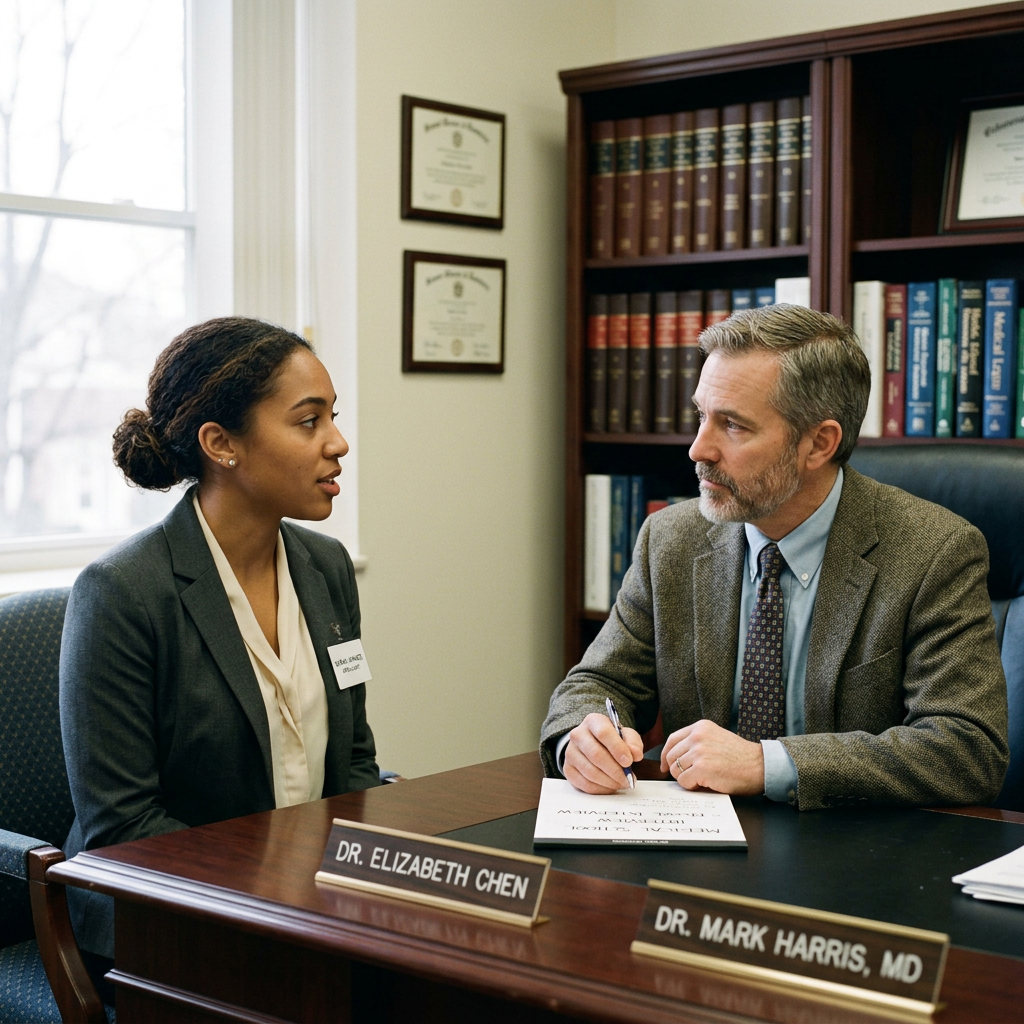
Every October, somewhere in Britain, a student opens a laptop with trembling hands.
The email begins politely.
“Thank you for your application…”
By the second line, they already know.
The words are always beautifully written, almost elegant in their cruelty. The university thanks them for their interest, congratulates them on the quality of their application, wishes them every success in the future… and quietly closes a door that may have occupied their imagination for the last ten years.
It is one of the strangest rituals in British education.
Every year, thousands of intelligent, hardworking young people are rejected from medical school. Not because they are lazy. Not because they are incapable. Quite often, not even because they are academically weaker than those who receive offers.
Some have achieved straight A*s. Some have outstanding UCAT scores. Others have spent years volunteering in hospitals, care homes and charities, collecting certificates, shadowing doctors and filling notebooks with reflections they hope will prove they are compassionate enough to deserve a place.
Then the rejection arrives anyway.
From the outside, it makes no sense.
Parents ask the same question.
Teachers ask the same question.
The applicants ask it more quietly, usually around two o’clock in the morning while scrolling through forums full of strangers wondering exactly the same thing.
“What did I do wrong?”
The uncomfortable truth is that many of them did nothing obviously wrong.
Instead, they made dozens of tiny mistakes.
Each one almost invisible.
Together, they became fatal.
Take Oliver.
On paper, he looked unstoppable.
Predicted AAA*.
Excellent GCSEs.
Captain of the rugby team.
Volunteer at a local hospice.
Strong UCAT score.
By every measurable standard, he looked like the sort of applicant universities should fight over.
His teachers certainly believed so.
When his UCAS application was submitted, everyone assumed offers would follow.
Instead, every interview ended with polite smiles, warm handshakes and silence.
Four rejections.
No explanation.
Months later, during a mock interview organised for gap-year applicants, an experienced admissions tutor watched Oliver answer a single question.
“Why medicine?”
Oliver smiled confidently.
For almost four minutes he spoke without interruption.
He talked about resilience.
Scientific curiosity.
Leadership.
His fascination with anatomy.
The NHS.
His commitment to lifelong learning.
His desire to improve lives.
It sounded impressive.
When he finished, the tutor simply asked,
“That was excellent. Now tell me… where were you?”
Oliver looked confused.
“I don’t understand.”
“I heard lots of excellent phrases. But I never met you.”
That sentence stayed with him for months.
Applicants often believe interviews are examinations of knowledge.
In reality, they are usually examinations of authenticity.
Admissions tutors have heard every polished answer imaginable.
They have listened to thousands of students who have “always wanted to help people.”
Thousands who have “wanted to be doctors since childhood.”
Thousands who are “passionate about science.”
After a while, those words stop sounding meaningful.
They become wallpaper.
The applicants who stand out are rarely the ones with the cleverest vocabulary.
They are the ones who sound unmistakably human.
One interviewer once remarked that within thirty seconds they could usually tell whether someone was speaking from memory or from experience.
Experience sounds untidy.
Memory sounds rehearsed.
The irony is that applicants spend months trying to eliminate every imperfection from their answers, when the imperfections are often what make them memorable.
Consider Emma.
She volunteered every Saturday in a dementia care home.
During one interview she was asked what she had learned there.
She could have spoken about compassion.
Or dignity.
Or multidisciplinary care.
Instead she laughed.
“The first thing I learned,” she said, “was never to play Scrabble against eighty-year-olds.”
The interviewer smiled.
Emma continued.
“One gentleman beat me every week. Then one afternoon he forgot my name completely. I realised dementia isn’t a straight line. Some parts disappear while others stay beautifully alive.”
The room changed.
For the first time that day, she wasn’t performing.
She was remembering.
That difference matters.
Applicants often imagine admissions tutors are searching for perfection.
They’re usually searching for potential.
Potential is quieter.
It appears in curiosity rather than certainty.
In reflection rather than performance.
In honesty rather than polish.
Perhaps the biggest misconception surrounding medical school applications is that universities are selecting future students.
They aren’t.
They’re selecting future colleagues.
Imagine interviewing someone who may one day look after your parents.
Would you choose the person with the most sophisticated answer?
Or the one who listens carefully before speaking?
Medicine is full of uncertainty.
Patients don’t read textbooks before arriving in hospital.
They don’t present beautifully.
They interrupt.
They cry.
They contradict themselves.
Sometimes they don’t know what’s wrong.
Sometimes neither does the doctor.
Applicants who desperately chase the “correct answer” often miss the point entirely.
Medical schools aren’t looking for encyclopaedias.
They’re looking for minds that remain calm when certainty disappears.
That is why some average answers receive offers while technically flawless performances quietly disappear into rejection folders.
Reflection has become one of the most misunderstood words in medicine.
Students think reflection means describing what happened.
It doesn’t.
Reflection begins where description ends.
Almost everyone can describe an event.
Far fewer can explain how it changed them.
Admissions tutors remember people who evolved.
Not people who simply accumulated experiences.
One student spoke passionately about observing open-heart surgery.
Another spent ten minutes discussing making tea for lonely patients in a community hospital.
Guess which conversation lasted longer?
Not because making tea is medically significant.
Because loneliness is.
Because observation is.
Because humanity often reveals itself in ordinary moments rather than extraordinary ones.
Perhaps the hardest lesson is this:
Medicine rewards humility far more than confidence.
Confident applicants sometimes feel the need to answer every question.
Strong applicants are comfortable saying,
“I don’t know.”
Followed immediately by,
“But here’s how I’d start thinking about it.”
That sentence tells interviewers something profoundly reassuring.
It says this person won’t guess when lives depend on accuracy.
They’ll reason.
They’ll ask.
They’ll learn.
Those are remarkably medical qualities.
Every admissions cycle produces stories that become legends among applicants.
The student who fainted during an interview and still received an offer.
The candidate whose train was cancelled yet somehow arrived smiling.
The applicant who admitted they had misunderstood the question and started again.
These stories survive because they reveal something fundamental.
Resilience is rarely dramatic.
More often, it is simply continuing after embarrassment.
Every future doctor eventually discovers that medicine is not a profession for perfect people.
It is a profession for recoverers.
People who make mistakes, acknowledge them honestly, learn quickly and keep walking.
The interview is often the first opportunity to demonstrate exactly that.
Years after applications have been forgotten, almost nobody remembers their UCAT score.
Consultants don’t introduce themselves by announcing percentile rankings.
Patients never ask where their doctor ranked nationally in abstract reasoning.
They care whether someone listens.
Whether someone explains.
Whether someone notices fear hiding behind ordinary words.
Ironically, these are precisely the qualities that applicants worry about the least while preparing.
Perhaps the greatest mistake isn’t choosing the wrong university or saying the wrong sentence during an interview.
Perhaps it is believing that admission depends on constructing a perfect version of yourself.
Because medicine has never needed perfect people.
It needs trustworthy ones.
If there is one lesson worth carrying into every interview room, every MMI station and every difficult conversation, it is this:
Stop trying so hard to sound like a doctor.
Instead, sound like the person who deserves to become one.
The difference is subtle.
But every admissions tutor in Britain hears it.


Leave a Reply