
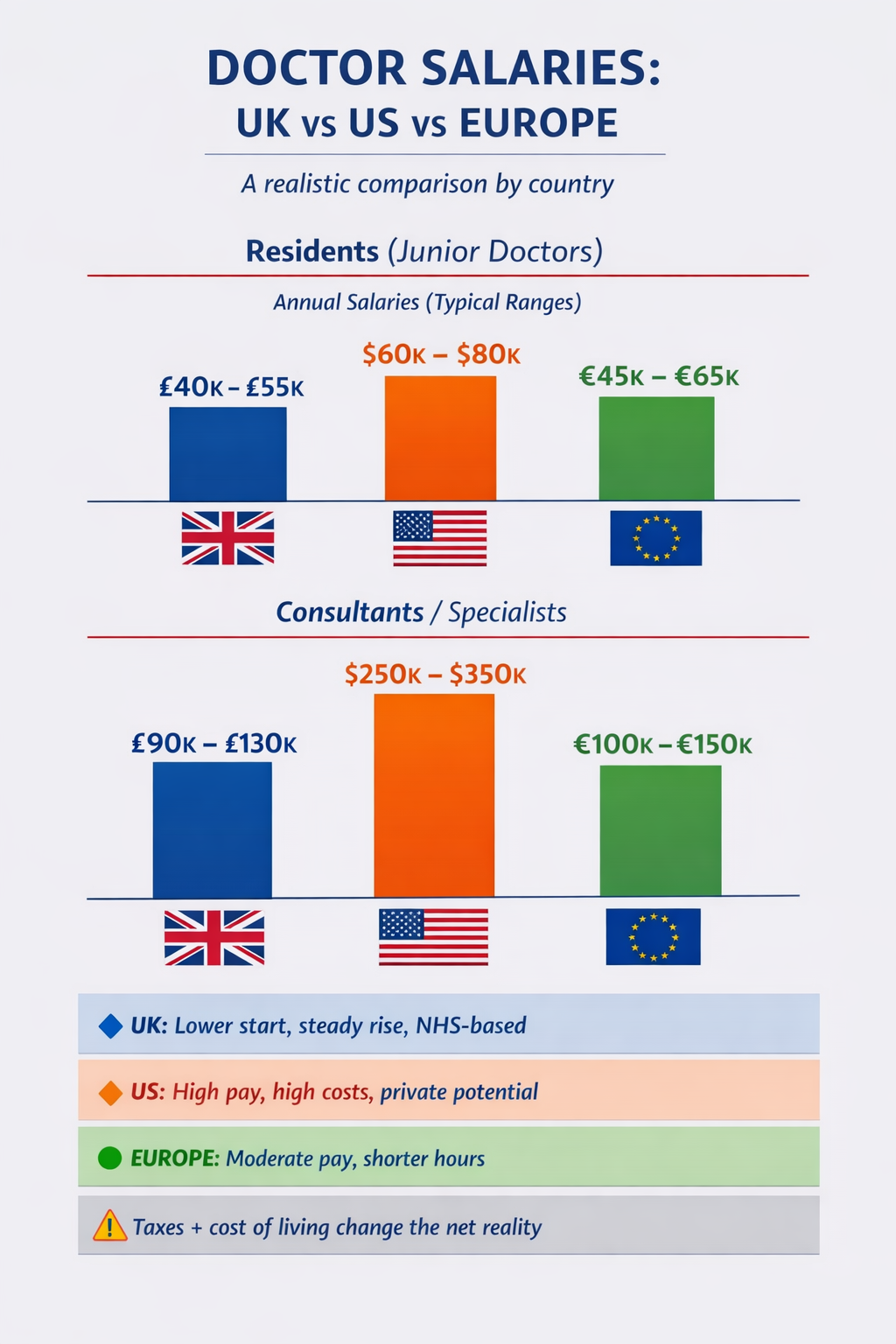
This question is no longer whispered. It is asked openly by students, parents, teachers, and increasingly by doctors themselves. It appears on LinkedIn far more than on student forums, usually framed with a quiet concern: Is this still a sensible path?
For years, medicine was treated as a guaranteed trade-off. Work hard, sacrifice early, and stability would follow. In 2026, that assumption deserves scrutiny.
Why this question is trending now
Three things have changed the conversation.
First, junior doctor industrial action has made working conditions visible in a way they never were before. Second, rising student debt and cost of living have reframed medicine as a financial decision, not just a vocational one. Third, alternative careers — in technology, finance, consulting, and even healthcare-adjacent roles — now offer faster rewards with less personal cost.
LinkedIn reflects this shift because it is where professionals, not applicants, talk honestly.
The reality of medical training today
Studying medicine in the UK still means:
- Five to six years at medical school
- Two foundation years with frequent rotations
- Long hours, weekend work, and emotional load
- Delayed financial independence compared to peers
This is not new. What is new is how openly it is discussed.
Medical students now graduate into a system under strain. The NHS relies heavily on goodwill, flexibility, and resilience — qualities students must bring with them, not expect to develop later.
The financial question (without sugar-coating)
Medicine is no longer the fastest route to financial security.
Compared with peers who enter:
- Technology
- Law
- Finance
- Engineering
Doctors often:
- Earn later
- Accumulate more debt
- Delay major life milestones
That said, medicine still offers long-term stability, predictable progression, and international mobility — advantages many careers do not.
So why do people still choose medicine?
Because despite everything, medicine offers something rare: meaningful responsibility.
Doctors are trusted at moments when people are frightened, vulnerable, or facing irreversible decisions. That responsibility is heavy, but for some, it is deeply fulfilling.
Many students who thrive in medicine do not do so because it is “worth it” on paper, but because they cannot imagine being satisfied elsewhere.
Who medicine still suits well in 2026
Medicine remains a good choice for people who:
- Value purpose over rapid reward
- Can tolerate delayed gratification
- Are comfortable with uncertainty
- Prefer structured progression
- Want a career that cannot be automated or outsourced
It suits those who want to do something that matters, even when it is difficult.
Who should think very carefully
Medicine may not be the best choice for those who:
- Primarily value income or lifestyle flexibility
- Struggle with prolonged pressure
- Expect prestige to compensate for dissatisfaction
- Are pursuing it mainly due to family expectation
These are not moral judgements. They are practical ones.
A note for parents and advisers
Encouraging a child into medicine because it is “safe” is no longer accurate. Encouraging them because it aligns with their temperament, values, and resilience may still be wise.
The worst outcomes often arise not from medicine itself, but from misaligned expectations.
The honest conclusion
Medicine in the UK is still worth it — for the right people.
It is not a shortcut to success. It is not a guaranteed route to wealth. It is not a shield against stress.
It remains a demanding, often frustrating, occasionally extraordinary profession.
Those who choose it with clear eyes tend to endure.
Those who choose it blindly often struggle.
The question is no longer “Is medicine worth it?”
It is “Is medicine worth it for you?”
Doctor Salaries in the UK (NHS)
Residents (Junior Doctors) and Consultants
Resident Doctors (formerly “Junior Doctors”)
| Career Stage | Typical NHS Salary (Annual, £) | What This Means in Practice |
|---|---|---|
| Foundation Year 1 (FY1) | £32,000 – £35,000 | First year after medical school; supervised practice |
| Foundation Year 2 (FY2) | £37,000 – £40,000 | More responsibility, still rotating specialties |
| Core / Internal Medicine Training (CT1–CT3 / IMT) | £40,000 – £50,000 | Specialty training begins; frequent on-calls |
| Specialty Registrar (ST3–ST5) | £50,000 – £60,000 | Increasing independence and senior responsibility |
| Senior Registrar (ST6–ST8) | £60,000 – £70,000 | Near-consultant level work |
🔹 Important notes for residents
- Salaries increase with banding, nights, weekends, and on-call duties
- Actual take-home pay varies by rota and region
- Long hours are common, especially early in training
Consultant Doctors (NHS)
| Consultant Level | Typical NHS Salary (Annual, £) | Notes |
|---|---|---|
| Newly Appointed Consultant | £93,000 – £100,000 | Starting salary after completing training |
| Mid-scale Consultant | £105,000 – £115,000 | After several years’ experience |
| Senior Consultant (Top of Scale) | £120,000 – £130,000 | Maximum NHS base salary |
| Consultant with Extra NHS Roles | £130,000+ | Clinical lead, management, or additional sessions |
🔹 Consultant salary considerations
- Private work can significantly increase income (specialty-dependent)
- London weighting and additional programmed activities raise pay
- Income grows slowly but steadily over time
Private Practice (Very Variable)
| Specialty Type | Typical Additional Income |
|---|---|
| High-demand procedural specialties | £50,000 – £150,000+ |
| Mixed NHS / private specialties | £20,000 – £80,000 |
| Largely NHS-based specialties | Minimal to none |
Private income depends heavily on:
- Specialty
- Location
- Reputation
- Time available
It is not guaranteed and should not be assumed.
The reality applicants should understand
- Doctors in the UK earn later than many professionals
- Training is long, structured, and demanding
- Financial stability improves significantly after consultancy
- Medicine offers security and employability, not fast wealth
A simple comparison
| Career Stage | Medicine | Many Other Professions |
|---|---|---|
| Early 20s | Student / low income | Graduate salary |
| Late 20s | Resident doctor | Mid-career earnings |
| 30s | Consultant | Senior professional |
| Long-term | Stable, transferable career | Variable |
Key message for applicants and parents
Medicine in the UK is not poorly paid, but it is slowly paid.
Those who choose it must be comfortable with delayed financial reward.


Leave a Reply